
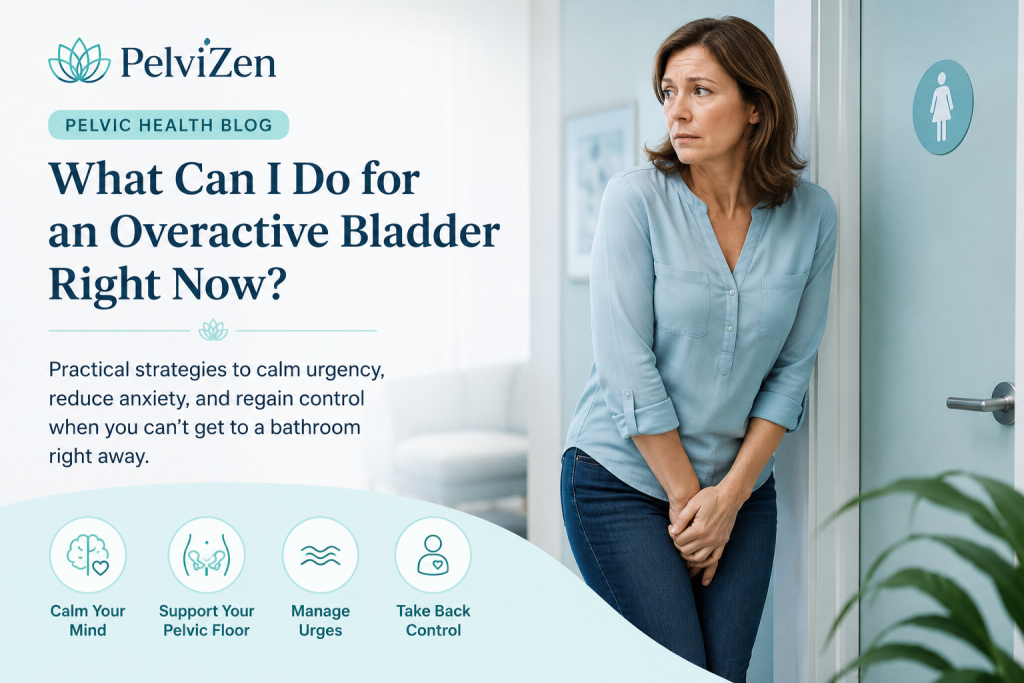

If you live with an overactive bladder (OAB), you’ve probably heard all the usual advice:
- Avoid bladder irritants like caffeine and alcohol.
- Practice bladder training.
- Consider pelvic floor therapy.
- Talk to your healthcare provider about medications.
But what about right now?
What about the moment when you’re standing in line at the grocery store, stuck in traffic, sitting through a meeting, or walking across a parking lot—and suddenly your bladder decides:
“I need to go. Right now.”
Not in ten minutes.
Not when it’s convenient.
Now.
Your heart starts racing. You begin scanning for the nearest bathroom. You try to stay calm, but the urgency keeps building. Before long, it feels like you’re in a battle that you’re about to lose.
So what can you do?
Not Sure What to Try Next?
Understanding why you’re waking up at night is the first step—but knowing what to do next can still feel overwhelming.
The PelviZen Marketplace helps you compare physician-reviewed pelvic health products, bladder support devices, pelvic floor trainers, leak protection products, coaching programs, and lifestyle interventions in one place.
✓ Browse by symptom
✓ Compare evidence
✓ Understand typical costs
✓ Find products matched to your goals
First: Put the Urge Into Perspective
One of the most frustrating things about overactive bladder is that the urgency feels like an emergency.
But in many cases, your bladder is not actually full.
The signal you’re receiving is often stronger than the amount of urine your bladder is holding.
If you were sitting comfortably at home with a bathroom nearby, you might be able to ignore that same urge without much trouble. But when you’re in a situation where a bathroom isn’t immediately available, anxiety enters the picture.
Your brain starts treating the situation like a crisis.
That anxiety can amplify the urgency signal, creating a cycle:
Urgency → Anxiety → More Urgency → More Anxiety
Understanding this cycle can be powerful. The sensation is real, but it doesn’t necessarily mean your bladder is at its limit.
Remember: Urges Often Come in Waves
One of the most important things to know is that urges frequently peak and then fade.
Many people assume that once an urge starts, it will continue getting stronger until an accident occurs.
That’s not always true.
If you can stay calm and avoid rushing immediately toward a bathroom, you may notice the intensity decreases after a minute or two.
The urge may return later, but you’ve bought yourself valuable time.
Try an Urge Suppression Strategy
When urgency strikes:
- Stop moving if possible.
- Take slow breaths.
- Stay still for a moment rather than rushing.
- Tell yourself:
- “This feeling will pass.”
- “My bladder is sending a signal, not an emergency.”
- “I have handled this before.”
- If you know how to perform pelvic floor contractions, a few quick squeezes may help calm the bladder signal.
The goal isn’t to make the urge disappear immediately.
The goal is to reduce the panic surrounding it.
Practice When the Stakes Are Low
One of the best places to build confidence is at home.
The next time you feel an urge and a bathroom is readily available, pause for a moment before going.
Notice what happens.
Notice that the urge often settles.
Notice that your bladder can tolerate a little more time than your brain initially suggests.
These low-stress situations are opportunities to train both your bladder and your confidence.
Over time, those experiences become evidence that you can handle urgency even when you’re away from home.
Have a Backup Plan
Let’s be realistic.
Sometimes the urge wins.
Sometimes there isn’t a bathroom nearby.
Sometimes accidents happen.
Having a backup plan doesn’t mean you’re giving up—it means you’re prepared.
A change of clothes, absorbent products, or knowing where restrooms are located can reduce anxiety significantly.
Ironically, when people feel prepared for the worst-case scenario, urgency often becomes easier to manage.
The Goal Is Progress, Not Perfection
Learning to manage overactive bladder is a process.
Some days will be easier than others.
Every time you successfully delay an urge, stay calm in a stressful situation, or challenge the anxiety that accompanies urgency, you’re building a skill.
Remember:
Your bladder is not the boss.
It may be loud.
It may be persistent.
But with practice, preparation, and the right tools, you can regain control.
Not Sure What’s Causing Your Symptoms?
Feeling like you always need to know where the nearest bathroom is? You’re not alone.
PelviZen was designed to help you better understand whether your symptoms may be more consistent with overactive bladder, stress urinary incontinence, or a combination of both.
Our free assessment walks you through your symptoms and provides personalized educational guidance to help you take the next step with confidence.
Start Your Free Assessment Today
Take the first step toward understanding your symptoms and regaining confidence.
We’d Love to Hear From You
What do you tell yourself when a strong urge hits?
Have you found a self-talk strategy, breathing technique, or other trick that helps you get through those difficult moments?
Share your experiences in the comments below. Your story may help someone else who’s struggling with the exact same thing.
Educational Disclaimer: This content is provided for educational purposes only and is not intended to diagnose, treat, cure, or prevent any disease or medical condition. Individual results may vary. Always consult your healthcare provider regarding your specific medical concerns.

Leave a Reply