
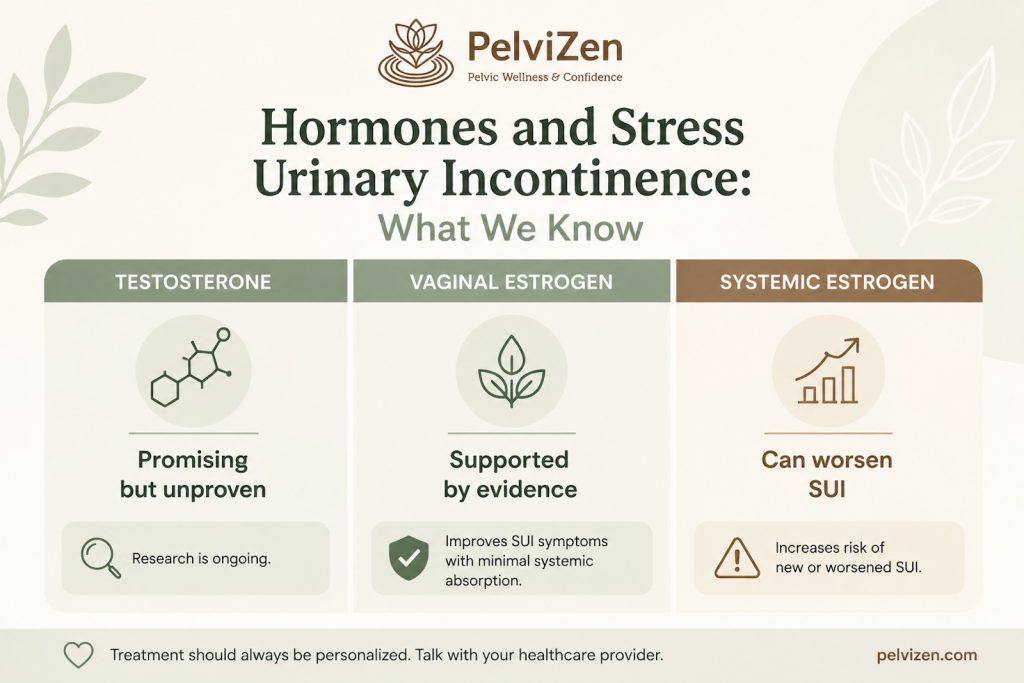

Many women ask, “Does testosterone help stress urinary incontinence?” It’s an important question because testosterone is increasingly being prescribed as part of hormone replacement therapy after menopause.
Could testosterone improve my bladder leakage?
It’s a great question, and one researchers are beginning to explore.
The short answer is:
Maybe—but we don’t know yet.
While several studies suggest that women with stress urinary incontinence tend to have lower testosterone levels, there is currently no clinical evidence proving that testosterone therapy treats stress urinary incontinence (SUI).
On the other hand, topical vaginal estrogen has considerably stronger evidence and is already recommended by many clinicians for appropriate postmenopausal women.
Let’s look at what the science actually says.
This article is educational and should not be interpreted as a recommendation to start or stop hormone therapy. Decisions about hormone therapy should always be made with your healthcare provider.
Not Sure What to Try Next?
Understanding why you’re waking up at night is the first step—but knowing what to do next can still feel overwhelming.
The PelviZen Marketplace helps you compare physician-reviewed pelvic health products, bladder support devices, pelvic floor trainers, leak protection products, coaching programs, and lifestyle interventions in one place.
✓ Browse by symptom
✓ Compare evidence
✓ Understand typical costs
✓ Find products matched to your goals
First, What Is Stress Urinary Incontinence?
Stress urinary incontinence (SUI) occurs when urine leaks during activities that increase pressure inside the abdomen, such as:
- Coughing
- Snezing
- Laughing
- Jumping
- Running
- Lifting weights
Unlike overactive bladder, SUI is generally caused by weakness of the pelvic floor muscles and reduced support around the urethra.
Why Are Researchers Interested in Testosterone?
Testosterone is often thought of as a male hormone, but women naturally produce testosterone throughout life.
In women it contributes to:
- Muscle strength
- Connective tissue health
- Sexual function
- Energy
- Bone health
Researchers have also discovered androgen receptors throughout the pelvic floor, including the:
- Levator ani muscles
- Urethra
- Bladder
- Pelvic connective tissues
This raises an important question:
Could declining testosterone contribute to weakening of the pelvic floor?
What the Human Studies Show
Several observational studies have reached remarkably similar conclusions.
Women with lower testosterone levels appear to have higher rates of stress urinary incontinence.
For example:
NHANES Study
Researchers analyzed more than 2,300 women.
Women in the lowest testosterone group were:
- 45% more likely to report stress urinary incontinence
- More likely to report mixed urinary incontinence
- No more likely to report urge incontinence
That distinction is interesting because it suggests testosterone may be more closely related to pelvic floor support than bladder urgency.
Postmenopausal Women
Another study found women with SUI had significantly lower testosterone levels than women without leakage—even after accounting for:
- Age
- Weight
- Number of pregnancies
- Other common risk factors
2026 Research
More recent work went a step further.
Researchers found that:
- Lower testosterone levels correlated with more severe stress urinary incontinence
- Other hormones such as DHEA, SHBG, and androstenedione did not show the same relationship
These findings strengthen the association.
But there is one very important limitation.
Correlation Does Not Mean Treatment
Finding that women with SUI have lower testosterone does not prove that increasing testosterone will fix the problem.
For example:
Women with severe SUI may exercise less.
Less exercise can reduce muscle mass.
Lower muscle mass may be associated with lower testosterone.
In that scenario, low testosterone could simply be a marker—not the cause.
This is exactly why randomized clinical trials are necessary.
What About Testosterone Therapy?
This is where the evidence becomes much thinner.
Despite growing interest in testosterone replacement therapy (TRT) for menopausal symptoms:
There are currently no randomized clinical trials showing that testosterone therapy improves stress urinary incontinence in women.
Several expert reviews—including the International Consultation on Incontinence Research Society (ICI-RS)—have concluded that:
- The biologic rationale is promising.
- The observational evidence is encouraging.
- Human treatment studies are still lacking.
Because of this, no major medical society currently recommends testosterone therapy specifically to treat stress urinary incontinence.
Why Scientists Think Testosterone Could Help
Although human evidence is limited, laboratory studies are intriguing.
Animal studies have shown testosterone may:
- Prevent pelvic floor muscle atrophy
- Reverse muscle weakening
- Improve collagen support
- Improve urethral function
Researchers have even proposed that vaginal androgen therapy might someday work similarly to vaginal estrogen—providing local benefits while minimizing whole-body side effects.
But this remains a theory until clinical trials are completed.
What About DHEA (Prasterone)?
DHEA deserves its own discussion because it sits somewhere between estrogen and testosterone.
Intravaginal prasterone (Intrarosa®) is FDA-approved to treat painful intercourse caused by genitourinary syndrome of menopause.
After application, it is converted locally into both:
- Estrogen
- Testosterone
Several small studies have shown improvements in:
- Urgency
- Overactive bladder symptoms
- Bladder capacity
- Quality-of-life scores
However:
These studies primarily involved women with urgency urinary incontinence or overactive bladder—not stress urinary incontinence.
At present:
- No randomized trial has shown vaginal DHEA improves SUI.
- No professional society recommends it specifically for stress urinary incontinence.
It remains an interesting area of ongoing research.
Vaginal Estrogen: The Treatment With Stronger Evidence
Unlike testosterone, topical vaginal estrogen has been studied much more extensively.
Multiple systematic reviews and randomized trials have shown improvements in urinary symptoms among postmenopausal women.
A recent meta-analysis involving more than 2,100 women found topical vaginal estrogen was associated with significant improvements in:
- Stress urinary incontinence
- Urgency
- Frequency
- Nocturia
Other studies have demonstrated improvements in:
- Urethral closure pressure
- Vaginal tissue quality
- Periurethral blood flow
- Supportive tissues around the urethra
Unlike systemic estrogen, vaginal estrogen delivers very small amounts of hormone directly to local tissues with minimal systemic absorption.
Why Route Matters
One of the most confusing aspects of hormone therapy is that the same hormone can have different effects depending on how it is given.
| Therapy | Effect on Stress Urinary Incontinence | Evidence |
|---|---|---|
| Low-dose vaginal estrogen | Improves symptoms in many postmenopausal women | Strong |
| Oral systemic estrogen | Worsens SUI | Strong |
| Combined systemic estrogen/progestogen | Worsens SUI | Strong |
| Testosterone therapy | Promising but unproven | Limited |
| Vaginal DHEA (prasterone) | Possible benefit for urgency symptoms; insufficient evidence for SUI | Limited |
This is one reason recommendations from your healthcare provider may seem contradictory.
Is Vaginal Estrogen Safe?
Many women worry because vaginal estrogen products historically carried the same boxed warning as oral estrogen.
Fortunately, research over the past decade has been reassuring.
Low-dose vaginal estrogen has not been shown to increase the risk of:
- Breast cancer (in the general population)
- Endometrial cancer
- Stroke
- Blood clots
- Heart disease
Because absorption into the bloodstream is minimal, estrogen levels generally remain within the normal postmenopausal range.
Most women do not require a progesterone medication when using low-dose vaginal estrogen alone, although any postmenopausal bleeding should always be evaluated.
Women with a history of estrogen-sensitive breast cancer should discuss treatment options with both their gynecologist and oncologist. Current guidelines generally recommend nonhormonal therapies first, but low-dose vaginal estrogen may be appropriate in selected patients after shared decision-making.
So Should You Use Testosterone for Bladder Leakage?
Based on today’s evidence:
Testosterone
✔ Lower levels are associated with stress urinary incontinence.
✔ There is a biologically plausible reason it could help.
✔ Animal studies are encouraging.
❌ No clinical trials have demonstrated that testosterone therapy treats SUI.
❌ It is not currently recommended as a treatment for stress urinary incontinence.
Vaginal Estrogen
✔ Supported by multiple randomized studies.
✔ Improves local tissue health.
✔ Can reduce stress urinary incontinence symptoms in many postmenopausal women.
✔ Generally has an excellent safety profile when used at low doses.
The Bottom Line
Testosterone may eventually become part of the conversation around stress urinary incontinence, but we’re not there yet.
Current research suggests that women with lower testosterone levels are more likely to experience stress urinary incontinence, and laboratory studies provide a compelling biologic explanation. However, we still do not have clinical evidence showing that testosterone replacement therapy improves bladder leakage.
In contrast, low-dose vaginal estrogen has substantially stronger evidence and is currently the hormone therapy with the best-supported role in improving urinary symptoms related to menopause.
If you’re experiencing bladder leakage, hormone therapy is only one piece of the puzzle. Pelvic floor muscle training, lifestyle changes, continence devices, and, in some cases, procedures or surgery may also play an important role.
The best treatment depends on the type of incontinence you’re experiencing and the factors contributing to it.
Explore evidence-based treatment options for stress urinary incontinence in the PelviZen app.
Evidence note: Research on testosterone for stress urinary incontinence is still in its early stages. Most available human studies show an association between lower testosterone levels and stress urinary incontinence, but they do not prove that testosterone therapy improves bladder leakage. In contrast, low-dose vaginal estrogen has been evaluated in multiple clinical studies and currently has stronger evidence supporting its use in appropriate postmenopausal women.
Here’s What You Should Do Next
If you’re wondering whether hormone therapy could help your bladder leakage, the most important first step is identifying why you’re leaking urine. Different types of urinary incontinence respond to different treatments, and the best approach depends on your individual symptoms and health history.
Consider talking with your healthcare provider about vaginal estrogen if:
- You’re postmenopausal and your bladder leakage began or worsened after menopause.
- You also have symptoms of genitourinary syndrome of menopause (GSM), such as vaginal dryness, burning, irritation, or discomfort during intercourse.
- You experience stress urinary incontinence along with other menopausal urinary symptoms.
- You’re looking for a conservative treatment with a strong evidence base.
Among hormone therapies, low-dose vaginal estrogen currently has the strongest clinical evidence for improving urinary symptoms related to menopause.
Testosterone probably isn’t the next step if:
- You’re looking for a proven treatment specifically for stress urinary incontinence.
- You don’t have another medical reason to consider testosterone therapy.
- You’re expecting testosterone replacement to reliably stop bladder leakage.
Although lower testosterone levels have been associated with stress urinary incontinence, research has not yet shown that testosterone therapy improves bladder leakage, and it is not currently recommended as a standard treatment for SUI.
DHEA is an interesting area of research, but…
Current studies suggest vaginal DHEA may improve some urinary symptoms, particularly those related to overactive bladder and genitourinary syndrome of menopause. However, there is currently insufficient evidence to recommend DHEA specifically for stress urinary incontinence.
If hormones aren’t the right answer…
Many women with stress urinary incontinence improve through other evidence-based treatments, including:
- Pelvic floor muscle training
- Pelvic floor physical therapy
- Digital pelvic floor therapy programs
- Lifestyle and activity modifications
- Vaginal support devices and pessaries
- Home pelvic floor training devices
- Surgical procedures when conservative treatments aren’t enough
For many women, these treatments are more appropriate than hormone therapy and may provide greater improvement in bladder control.
How PelviZen Can Help
Stress urinary incontinence isn’t the same as overactive bladder, and treatments that work well for one condition may not be the best choice for another.
PelviZen helps you:
- Better understand whether your symptoms are most consistent with stress, urge, or mixed urinary incontinence.
- Compare evidence-based treatment options side-by-side.
- Learn the expected benefits, limitations, costs, and supporting research for each treatment.
- Build a personalized plan you can discuss with your healthcare provider.
Understanding your type of urinary incontinence is often the first step toward finding the treatment that’s most likely to help.
References
- Siddle N, Versi E. Stress Urinary Incontinence and the Forgotten Female Hormones. International Urogynecology Journal. 2022.
- Taithongchai A, Mohamed-Ahmed R, Sinha S, et al. Should Hormone Replacement Therapy (Any Route of Administration) Be Considered in All Postmenopausal Women With Lower Urinary Tract Symptoms? Report From the ICI-RS 2023. Neurourology and Urodynamics. 2024.
- Kim MM, Kreydin EI. The Association of Serum Testosterone Levels and Urinary Incontinence in Women. The Journal of Urology. 2018.
- Chen Y, Song X, Fang W, et al. Correlation of Serum Circulating Testosterone Levels With Stress Urinary Incontinence in Postmenopausal Women. World Journal of Urology. 2023.
- Chen Y, Ren Z, Yan J, Yu Y. Correlation of Serum Circulating Testosterone and Related Hormones With Stress Urinary Incontinence in Postmenopausal Women. Urology. 2026.
- Siddle N, Versi E. Stress Urinary Incontinence and the Forgotten Female Hormones. International Urogynecology Journal. 2022.
- Crandall CJ, Mehta JM, Manson JE. Management of Menopausal Symptoms: A Review. JAMA. 2023.
- Pinkerton JV. Hormone Therapy for Postmenopausal Women. New England Journal of Medicine. 2020.
- Constantine GD, Graham S, Lapane K, et al. Endometrial Safety of Low-Dose Vaginal Estrogens in Menopausal Women: A Systematic Evidence Review. Menopause. 2019.
- Crandall CJ, Hovey KM, Andrews CA, et al. Breast Cancer, Endometrial Cancer, and Cardiovascular Events in Participants Who Used Vaginal Estrogen in the Women’s Health Initiative Observational Study. Menopause. 2018.
- Collaborative Group on Hormonal Factors in Breast Cancer. Type and Timing of Menopausal Hormone Therapy and Breast Cancer Risk: Individual Participant Meta-analysis of the Worldwide Epidemiological Evidence. The Lancet. 2019.
- Gartlehner G, Patel SV, Reddy S, et al. Hormone Therapy for the Primary Prevention of Chronic Conditions in Postmenopausal Persons: Updated Evidence Report and Systematic Review for the U.S. Preventive Services Task Force. JAMA. 2022.
- Collà Ruvolo C, Ursino M, Formisano C, et al. Urodynamic Evaluation of Prasterone Vaginal Treatment of Mild to Moderate Urge Incontinence in Women With Vulvovaginal Atrophy. Menopause. 2025.
- Matarazzo MG, Sarpietro G, Fiorito D, et al. Intravaginal 6.5 mg Prasterone Administration in Postmenopausal Women With Overactive Bladder Syndrome: A Pilot Study. European Journal of Obstetrics, Gynecology, and Reproductive Biology. 2021.

Leave a Reply