

Introduction
Hormone therapy for overactive bladder has become an area of growing interest, especially for women experiencing bladder urgency after menopause.
If you’ve already read my article on hormones and stress urinary incontinence, you may be wondering whether hormones also help overactive bladder (OAB).
The answer is yes, but the type of hormone matters tremendously.
Some hormone treatments can actually make bladder symptoms worse, while others are supported by good clinical evidence.
What Is Overactive Bladder?
Hormone therapy for overactive bladder isn’t appropriate for everyone, but some women may benefit depending on the type of hormone used.
Symptoms include
- sudden strong urges to urinate
- frequent urination
- waking multiple times at night
- leaking because you couldn’t make it to the bathroom
Unlike stress urinary incontinence, OAB is primarily a bladder muscle and nerve problem.
Menopause and the Bladder
After menopause:
- estrogen receptors decrease
- bladder lining thins
- urethral tissue becomes less healthy
- vaginal tissues become less acidic
- beneficial bacteria decrease
This combination can increase urgency and frequency.
Not Sure What to Try Next?
Understanding why you’re waking up at night is the first step—but knowing what to do next can still feel overwhelming.
The PelviZen Marketplace helps you compare physician-reviewed pelvic health products, bladder support devices, pelvic floor trainers, leak protection products, coaching programs, and lifestyle interventions in one place.
✓ Browse by symptom
✓ Compare evidence
✓ Understand typical costs
✓ Find products matched to your goals
Not All Hormone Therapy Works the Same
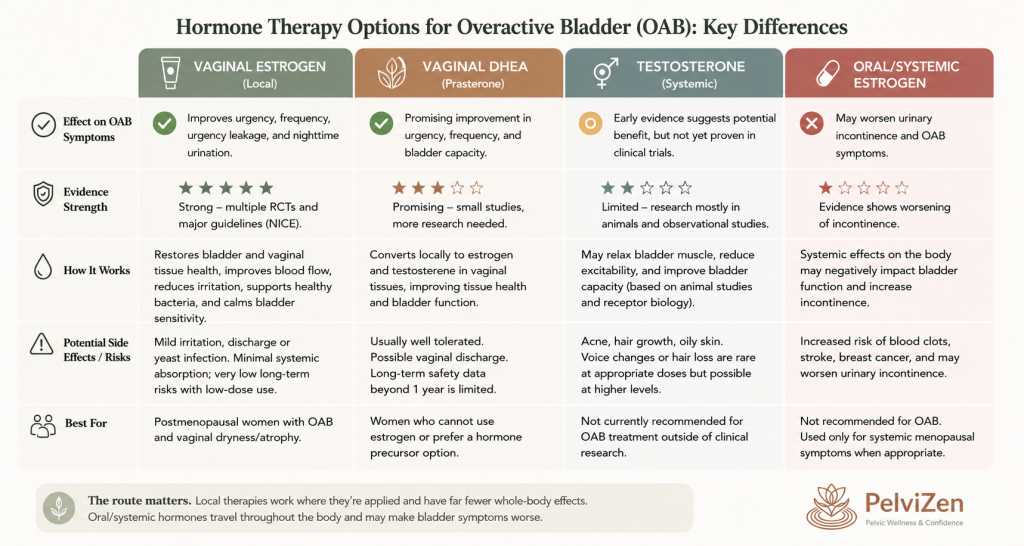
1. Vaginal Estrogen
What the evidence says
Multiple randomized trials show improvements in
- urgency
- frequency
- urgency leakage
- nighttime urination
What NICE recommends / The National Institute for Health and Care Excellence (NICE)
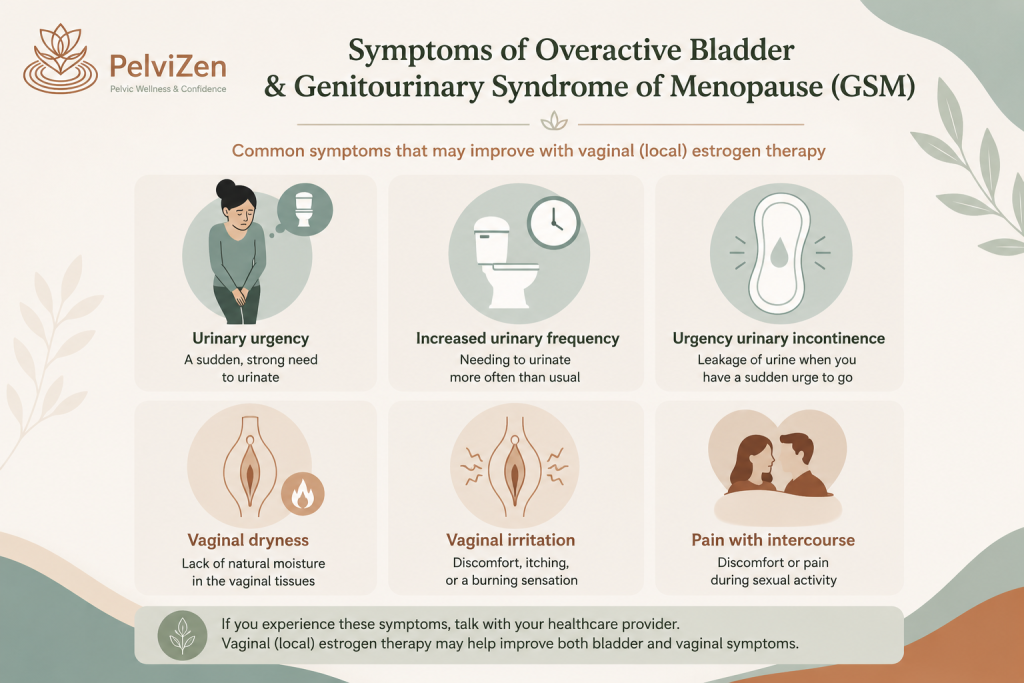
For postmenopausal women who have both overactive bladder symptoms and signs of genitourinary syndrome of menopause (vaginal atrophy), NICE recommends:
Intravaginal (local) estrogen therapy should be considered.
This recommendation specifically applies to women experiencing symptoms such as:
Oral Estrogen Is Different
Oral estrogen may actually worsen bladder leakage.
Studies involving nearly 20,000 women found oral hormone therapy increased urinary incontinence, while low-dose vaginal estrogen improved symptoms.
Local estrogen restores bladder tissue rather than flooding the whole body with estrogen.
Local estrogen
Appears to:
- improve bladder lining
- improve blood flow
- improve vaginal health
- restore healthy bacteria
- reduce bladder irritation
- improve bladder muscle signaling
Common prescription products
- Estrace® cream
- Premarin® cream
- Vagifem® tablets
- Estring® ring
2. Vaginal DHEA (Prasterone)
DHEA is different.
Rather than supplying estrogen directly, it provides a precursor that vaginal tissues convert into both estrogen and testosterone locally.
Medication Usage Update
Please note that this medication is currently FDA-approved only for treating painful intercourse caused by menopause. It is not approved to treat Overactive Bladder (OAB).
Early studies are encouraging.
Small studies have shown improvements in
- urgency
- bladder capacity
- urinary frequency
- quality of life
But…
Large randomized trials are still needed.
Promising but not yet proven.
3. Testosterone
Researchers are increasingly interested in testosterone because bladder tissues contain androgen receptors.
Animal studies suggest testosterone may
- relax the bladder muscle
- improve bladder capacity
- reduce unwanted bladder contractions
Human studies have also found that women with lower testosterone levels tend to have more urinary symptoms.
However…
No large clinical trials have shown that testosterone replacement improves overactive bladder.
At this time testosterone should not be considered an established treatment for OAB.
Risks to Consider
What Should You Do Next?
If you’ve been experiencing urinary urgency, frequent trips to the bathroom, or urge leakage after menopause, hormones may be part of the picture, but they’re rarely the only factor. Understanding which therapies have the strongest evidence can help you have a more informed discussion with your healthcare provider.
Consider talking with your healthcare provider about vaginal estrogen if:
- You’re postmenopausal and have developed urgency, frequency, nighttime urination, or urge leakage.
- You also have symptoms of genitourinary syndrome of menopause (GSM), such as vaginal dryness, irritation, burning, or discomfort with intercourse.
- Your bladder symptoms began or worsened around menopause.
- You’ve already tried lifestyle changes but continue to have bothersome symptoms.
Among hormone therapies, low-dose vaginal estrogen has the strongest evidence for improving bladder symptoms related to menopause.
DHEA may be worth discussing if:
- You’re postmenopausal with symptoms of GSM.
- Vaginal estrogen isn’t appropriate or isn’t your preferred option.
- You’re interested in learning about newer hormonal approaches.
Current research is encouraging, but DHEA is not FDA-approved for overactive bladder, and more high-quality studies are needed before it can be recommended as a standard treatment.
Testosterone is probably not the next step if:
- You’re looking for a proven treatment specifically for overactive bladder.
- You don’t have another medical reason to consider testosterone therapy.
- You’re expecting it to reliably improve urgency or bladder control.
Although testosterone shows promise in laboratory and early clinical research, there isn’t enough evidence to recommend it as a routine treatment for overactive bladder in women.
If hormones aren’t the right answer…
Many women improve with other evidence-based treatments, including:
- Bladder training
- Pelvic floor physical therapy
- Digital pelvic floor therapy programs
- Lifestyle and fluid management strategies
- FDA-approved medications for overactive bladder
- Tibial nerve stimulation and other neuromodulation therapies
- Home electrical stimulation devices
- Advanced treatments for persistent symptoms
The most effective treatment depends on the underlying cause of your symptoms, your overall health, and your personal goals.
How PelviZen Can Help
Choosing among bladder treatments can feel overwhelming.
PelviZen helps you:
- Better understand whether your symptoms are consistent with overactive bladder, stress urinary incontinence, or mixed incontinence.
- Compare evidence-based treatment options side-by-side.
- Learn the benefits, limitations, and expected results of medications, therapies, devices, and procedures.
- Explore treatments that best fit your symptoms, preferences, and lifestyle.
The goal isn’t simply to find a treatment—it’s to find the treatment that’s most appropriate for you
PelviZen can help you understand your symptoms and learn about evidence-based treatment options tailored to your situation.
Take the free PelviZen assessment and discover your next best step.
References
- Do We Need to Know More About the Effects of Hormones on Lower Urinary Tract Dysfunction? ICI-RS 2014. Hanna-Mitchell AT, et al. Neurourology and Urodynamics. 2016.
- Oestrogens and Overactive Bladder. Robinson D, Cardozo L, et al. Neurourology and Urodynamics. 2014.
- Should Hormone Replacement Therapy (Any Route of Administration) Be Considered in All Postmenopausal Women With Lower Urinary Tract Symptoms? Report From the ICI-RS 2023. Neurourology and Urodynamics. 2024.
- Efficacy of Vaginal 17β-Estradiol on the Urinary Storage Symptoms in Postmenopausal Women. Scientific Reports. 2026.
- Does the Addition of Vaginal Oestrogen to Anticholinergic Medication Improve Overactive Bladder Symptoms? A Systematic Review and Meta-analysis. International Urogynecology Journal. 2026.
- Effect of Oral Estrogen on Overactive Bladder in Women: A Research Based on NHANES and Network Pharmacology. International Immunopharmacology. 2025.
- Prasterone: A Review in Vulvovaginal Atrophy. Drugs & Aging. 2019.
- Intravaginal 6.5 mg Prasterone Administration in Postmenopausal Women With Overactive Bladder Syndrome: A Pilot Study.
- Urodynamic Evaluation of Prasterone Vaginal Treatment of Mild to Moderate Urge Incontinence in Women With Vulvovaginal Atrophy.
- Global Consensus Position Statement on the Use of Testosterone Therapy for Women.
- Safety and Efficacy of Testosterone for Women: A Systematic Review and Meta-analysis of Randomised Controlled Trial Data.
- National Institute for Health and Care Excellence (NICE): Urinary Incontinence and Pelvic Organ Prolapse in Women (NG123). Updated guidance on the assessment and management of urinary incontinence and pelvic organ prolapse in women.

Leave a Reply